

Software company internationalization: how does it work?
In today’s increasingly interconnected and globalized context, companies face the process of penetrating new foreign markets, that is, a sort of internationalization of the products and services offered. The reasons that drive companies to enter new foreign markets can be varied: slowdown of markets where they are already present, growth of competition, or simply new profit opportunities. Whatever the reasons for this opening, it is necessary to decide which business strategies to pursue and possibly seek support from professionals in this delicate insertion process. Obviously, one cannot think of crossing national borders to obtain advantages and profits without first examining the health status of one’s own company. The requirements necessary upstream of an internationalization project are generally:
- economic-financial solidity;
- quality products and/or services suitable for target markets;
- competitive prices;
- reliable information system;
- resources (time, money, personnel) to invest.
Service export is less frequent and more difficult compared to manufactured products and involves an analysis based on some key macroeconomic elements. This is why it is worth dwelling on, focusing attention on a very ‘international’ service that could be taken as an example, namely the ‘technological’ one oriented toward optimizing resources within production companies. The first thing managers should do is verify the feasibility of their business models in their national market, perhaps first within their own company, also working on simulations and forecasts. When revenue growth proves profitable, predictable and scalable, it will be time, if desired, to conquer foreign markets. The next step is to understand and decide WHERE to go. This is where one must rely on some indispensable indicators, first and foremost the analysis of the BECH index, named after its Danish creator Hans Peter Bech, which is calculated and published annually by TBK Consult ApS. It represents an estimate of the relative capacity regarding B2B technology demand and related services worldwide. Looking at the latest report, we see that the Americas recorded a 12% drop up to the 2020s. Although demand from Central and South America showed an increase in 2019, the drop in demand from North America results in a net overall loss of 0.4 percent for the area. Europe lost 8 percent of global demand in the same period and after a slight increase in 2018, the decline continues in 2019. North America and Europe remain very interesting areas with some of the world’s largest markets. The markets with the greatest potential to date have proven to be: 1st Germany; 2nd France; 3rd Switzerland; 4th Poland; 5th Spain; 6th Russia; 7th UK; 8th Netherlands. And it is in these Countries that international investors should focus their resources.
Bech’s analysis is transferred into a very operational manual consisting of about twenty pages containing graphs resulting from the scholar’s macroeconomic analyses. Other interesting indicators for the internationalization of the mentioned service are the number of European manufacturing companies (target customer for the proposed services/market size) and labor costs. The higher the labor cost, the greater the need to ‘technologize’ production processes to reduce manpower and therefore related costs. Furthermore, it is necessary to conduct a careful analysis of projects already carried out in the market of interest and a study of the existing competition, performing a sector benchmark to avoid investing uselessly in a saturated or too complicated market.
Competitors are an important reference point, they can be analyzed to find their weaknesses and understand how to do better. In fact, there will never be two identical companies and, even if a market is already occupied, one can still find one’s own formula for success and conquer a segment of the public. Once all the indispensable indicators for an internationalization project have been considered, one must proceed to the operational phase of penetration adopting all the tools necessary for a winning approach. First of all, it is necessary to prepare, taking care of every element to not be caught unprepared by customers, starting from a simple request for information about the company and services offered. This involves the care of COMMUNICATION TOOLS, starting from the preparation of brochures and company presentations complete with photos and documentation, translated into the language of the country of interest, since language is always an indispensable asset to interact with local players. The goal is to obtain a partnership with some local distributor and/or with customers spread across the territory. Most operational activities therefore consist of conducting commercial negotiations with prospects and, whenever possible, going to meet them in person at their companies.
Internationalization should be considered, in all respects and in all professional sectors, as the start of a new business, finding new sources of financing made up of new business perspectives. As reported by ICE (Agency for the promotion abroad and internationalization of Italian companies), internationalized companies are more resilient to crises, record lower revenue drops, are more reactive to changes and faster in digital transformation. It is a rewarding choice but only if managed with awareness: for this reason, in planning operations, extreme attention and adequate resources must be dedicated to the processes of identifying and managing the specific risks of these activities.
Digitalization of labeling processes: how to implement an integrated traceability system
Good management of company operational processes is achieved by facilitating and speeding up activities. In most cases, this means ‘automating’ production phases with consequent cost reduction, shorter commercial times, and increased organizational efficiency. Automation enables optimizing complex printing processes, eliminating errors, and improving printing productivity. It is possible to integrate printing with existing company systems and hardware devices. This is why every company should adopt a product identification system through an efficient labeling system. Products need labels!
In the automotive sector or mechanical sectors, labeling ensures component traceability down to the smallest screw. In logistics, it guarantees delivery punctuality. In electrical appliances, labels indicate operating characteristics and usage. In the pharmaceutical industry, labeling prevents health-relevant errors, in chemistry it illustrates risks related to product handling with multicolored labels and without language barriers. On food, labeling provides information on composition, while on textiles it contains optimal care instructions.
The label is perceived as a growth area, but mainly in a digital perspective, a sort of all-in-one choice to compensate for lack of know-how. This, however, is a very reductive vision, because multiple skills must be involved in label production and it is extremely important to adapt production capacity to customer requirements. Materials, field of application, industrial process, stock management are just some of the elements that printers entering this sector must consider, remembering above all that the label is the mandatory and functional complement of the product for sale. Think of the importance of the label as an anti-counterfeiting system for the product. Counterfeiting impacts 5-7% of world trade, generating significant problems for original producers.
Therefore, a series of security features are continuously introduced on product labels and packaging to reduce counterfeiting effects, such as adhesives that make labels harder to remove. Requirements are higher the more niche or high-value products are involved, often related to the food sector. This issue is one of the most sensitive and Made in Italy products perceive it particularly. From these areas, therefore, come the greatest requests: web interactivity, physical identifications, immediate traceability are just some of the instances that are requested to be accessible through labeling.
Modern labeling management software allows complete autonomy in customizing the information to be recorded. Companies must be able to significantly reduce manual printing operations and reach new levels of precision and control thanks to on-demand printing features that allow company users to create customized printing applications, simplifying complex processes, eliminating errors, and facilitating the labeling system.
Mauro Chiaraluce, Business Development Manager at Horsa explains how to implement an integrated digital traceability system starting from industrial labeling with the support of the most advanced AIDC technologies:
Mauro Chiaraluce, Business Development Manager at Horsa explains how to implement an integrated digital traceability system starting from industrial labeling with the support of the most advanced AIDC technologies:
“Traceability of raw materials, semi-finished and finished products throughout the supply chain – from inside the plant, to exit and return from third parties, up to customers themselves – starts with a correct labeling process and requires the integration of different technologies and skills that take into account the type of raw materials, various production processes, and working conditions of the specific sector and company.
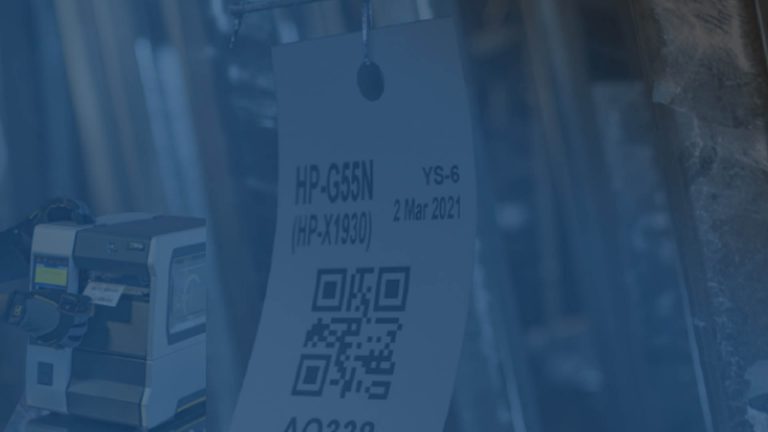
LMS (Label Management System), industrial thermal printers, specific labels for the surface they must be applied to, for the production process and for the environmental conditions they must withstand and resist: these are the elements to consider in implementing an advanced industrial labeling system.
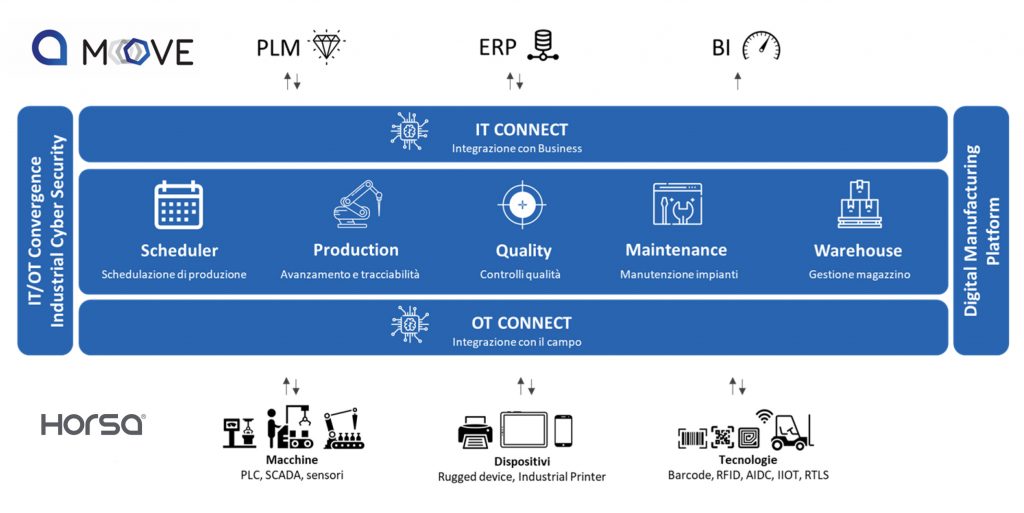
At Horsa we use an end-to-end approach for industrial traceability projects, thanks to MOVE the integrated Digital Manufacturing platform companies have the possibility to monitor step by step the production process, starting from raw material receipt and arriving at finished product delivery.
Supply Chain processes are internalized with the aim of simplifying production, making it leaner and having immediate information on any errors or changes to be made.”