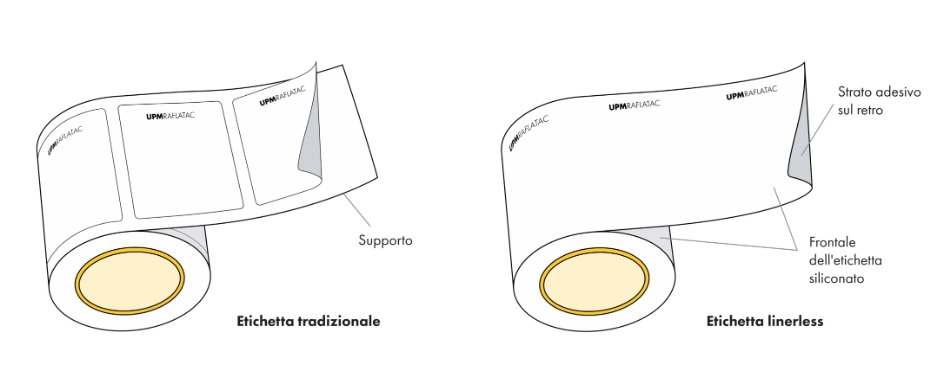

Optimizing the use of raw materials is a primary objective in all production sectors. The use of linerless labels, i.e., without the siliconized backing, is a key sustainability factor in reducing raw material waste in packaging. Therefore, to impact increasingly eco-sustainable carts, it is important not to underestimate the importance of green labeling of products, also considering that the label is a true communication tool with the consumer, strategically decisive in the choice processes leading to purchase. This happens precisely because of its informative qualities, but not only. In fact, the labels themselves can carry sustainability in their own design and composition.
An example of this front labeling contribution is offered by so-called linerless labels. This term refers to a type of adhesive label characterized by the absence of liner, i.e., without the siliconized backing that carries traditional labels before being applied to products. We recall that traditional liner-based labels are organized in rolls where the adhesive part of the label comes into contact with the “liner” and, once the labels are dispensed, it becomes waste material. In practice, linerless labels, by eliminating the waste deriving from the backing, significantly reduce carbon dioxide emissions to produce it. Only a portion of siliconized liner supports is recycled, the remaining part when disposed contributes to CO2 production, which costs both the environment and the company that must dispose of the waste material. It is estimated that over 600,000 tons of siliconized waste end up in landfills (source: Fortune Business Insight). Moreover, with this innovation, each roll contains about 30/40% more labels, ensuring convenience also in terms of productivity, flexibility, transportation and storage, with the consequent advantage of reducing the company’s carbon emissions. Without the liner, in addition to practical issues such as increased productivity and reduced downtime, there is also great customization potential for the labels themselves, opening up a great front also for targeted green marketing. According to a Fortune Business Insights report, it is expected that the global linerless labels market will reach 3.4 billion dollars by 2027, 5% more than in 2019. The absence of siliconized paper to dispose of means that linerless solutions represent a true step forward toward more sustainable labeling. The use of linerless labels can also help companies reduce fines. Eliminating waste improves safety and helps comply with OSHA (Occupational Safety and Health Administration) standards by reducing waste material that remains on warehouse floors and work areas during production.
We discuss this top topic with Dario Santilli, Packaging Solutions Manager at UPM Raflatac, a Finnish multinational world leader in the production of self-adhesive materials that has recently installed a new linerless production line in Poland.
We discuss this top topic with Dario Santilli, Packaging Solutions Manager at UPM Raflatac, a Finnish multinational world leader in the production of self-adhesive materials that has recently installed a new linerless production line in Poland.
“Linerless labels for direct thermal printing are a sustainable option compared to conventional self-adhesive materials for labels. Since there is no backing, issues related to label waste management are eliminated; moreover, linerless labels can be cut to any length optimizing costs, increasing flexibility and drastically reducing SKUs in stock.
At UPM RAFLATAC we have also developed OPTICUT™ adhesive technology for food, retail, logistics and quick service restaurant applications. Often with traditional adhesives, linerless labels, to achieve good adhesion, release glue residues due to cutting generating adhesive buildup. This causes paper jams and frequent printer maintenance interventions.
The revolutionary chemical composition of the OPTICUT™ adhesive range sets a new benchmark for the linerless labels industry. In short, OptiCut offers clean cuts, excellent adhesion and sharp print quality, drastically reducing maintenance interventions on cutting units.
All this without neglecting the sustainability aspect which for UPM Raflatac has been a distinctive feature for decades, in fact our entire Linerless range is Carbon Neutral and FSC® certified (FSC C012530). The origin of raw materials from sustainably managed forests protects wildlife, contributes to mitigating climate change and promotes biodiversity.”